Home Blog Page 441

Srinagar-Jammu NH open for one-way traffic

0
Srinagar-Jammu NH open for one-way traffic

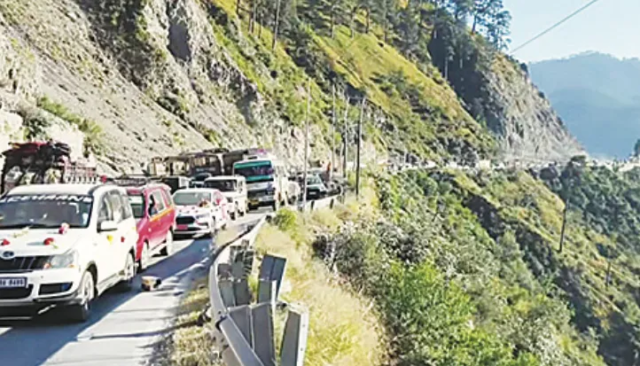
Ramban, Oct 13: The Srinagar-Jammu National Highway (NH-44) remained open for one-way traffic towards Kashmir on Monday.

However, the movement of traffic remained slow due to the ongoing road challenges.

According to traffic officials, Light Motor Vehicles (LMVs) and heavy vehicles were allowed to travel towards Srinagar on Monday, but the traffic flow remained sluggish.

The delays were primarily attributed to single-lane operations in several damaged stretches, poor road conditions, and the ongoing migration of nomadic families with livestock moving on foot towards Jammu.

On Monday morning and again in late afternoon, Srinagar-bound heavy vehicles were seen lined up at multiple checkpoints, waiting for the green signal to proceed.

Traffic officials said that vehicular movement was being regulated in a phased manner, particularly between Ramban and Banihal, where only one-way traffic was currently permitted.

Officials said that traffic was being carefully managed in vulnerable zones across the Udhampur-Banihal sector, where congestion was frequent.

Major bottlenecks have been identified at Thard, Balli Nullah, Dewal, Samroli, Nashri, Dalwass, Mehad, SeriMaroog, and Kishtwari Pattar.

The heavy on-foot movement of nomadic families with livestock has added to the complexity of traffic regulation, especially between Udhampur and Ramban.

Authorities say this seasonal migration is significantly impacting vehicular speed and safety along the already-constrained highway.

Traffic authorities have strongly advised commuters not to travel against the traffic advisory, warning that doing so could worsen congestion and increase safety risks.

Motorists have been urged to check the latest road status before starting their journeys at Traffic Control Units in Srinagar, Ramban, Udhampur, and Jammu.

Authorities also advised following official social media updates from the J&K Traffic Police for real-time advisories.


Greater Kashmir

3-day interstate cultural festival to begin today

0
3-day interstate cultural festival to begin today

Srinagar, Oct 13: Srinagar is all set to witness a three-day interstate cultural festival commencing from Tuesday at Tagore Hall, Srinagar.

The organisers said the festival is aimed at celebrating the unity and spirit of the Nation through music, dance, Art, and painting competitions for the students and artists.

The three-day festival is being organised by the Delphic Council of J&K in collaboration with the Academic of Arts, Culture and Language, J&K, and NZCC.

“The aim is not only to exhibit art, craft, and culture but to celebrate the cultural unity of India,” the organisers told media persons here. The organisers have brought together a distinguished group of artists, intellectuals, and cultural enthusiasts from Jammu and Kashmir besides other artists from different states.

The second day of the festival will witness Kashmiri Sufiyana Mousiqee by Ustad Mohammad Yaqoob Shaikh while folk melodies like Chakri will also be performed by Gulzar Ahmed Ganai and Abdul Rashid Hafiz.

Vikram Sirohiwal from Chandigarh will perform a Sufi melody.

Renowned singers Darmesh Nargotra, Waheed Jeelani, Deepali Wattal, and Assad Anjum will also be seen performing on the stage.

The three-day inter-state cultural festival will act as a bridge between J&K and the rest of the country to bring peace and tourism to J&K.

An exhibition of Basohli Miniature paintings and traditional artworks will also be showcased during the three-day festival.

————-

Greater Kashmir

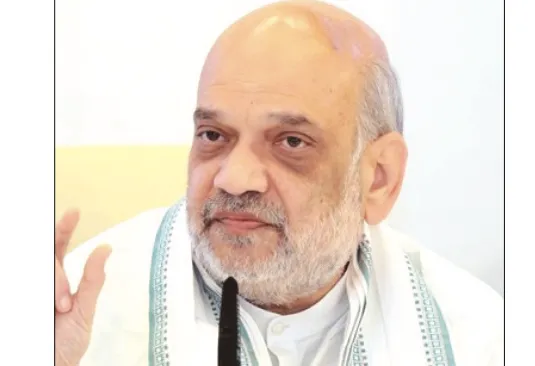
Amit Shah launches Rs 4 lakh crore investment projects in Rajasthan

0
Govt committed to social justice: Amit Shah

Jaipur, Oct 13: Union Home Minister and Minister of Cooperation Amit Shah on Monday inaugurated a state-level exhibition on India’s new criminal laws and performed the ground-breaking ceremony for investment proposals worth Rs 4 lakh crore in Jaipur, Rajasthan.

He also inaugurated and laid the foundation stone for multiple development projects of the Rajasthan government.

The event was attended by Rajasthan Chief Minister Bhajan Lal Sharma, Union Home Secretary Govind Mohan, and other senior officials. Speaking at the event, Shah said the programme marked the synergy of development and justice, highlighting two major initiatives, reforms in the criminal justice system and accelerated industrial investment in the state. He said the new exhibition aims to make citizens aware of the three new criminal laws that replace colonial-era legislations, ensuring simpler and faster access to justice.

According to Amit Shah, these new laws, to be fully implemented by 2027, will guarantee justice within three years of any FIR and focus on “justice rather than punishment.” He said the reforms, introduced under the leadership of Prime Minister Narendra Modi, represent a “historic shift” from British-era laws to Indian-made laws designed for Indian citizens.

The Home Minister noted that the laws include new provisions on women’s and children’s safety, e-FIR and zero FIR, mandatory videography of seizures, and forensic investigation for serious crimes. He also said that Rajasthan’s conviction rate has risen from 42 percent to 60 percent within a year of their partial implementation and could reach 90 percent once fully operational.

Mit Shah further said that for effective enforcement, the National Forensic Science University (NFSU) and its affiliated colleges are training a new cadre of forensic professionals nationwide. The laws, he added, also define offences like terrorism, mob lynching, organized crime, and digital crime for the first time and set strict time limits for investigation and trial.

Greater Kashmir

Kishtwar, Baramulla selected as ‘Aspirational Agricultural Distts’ under PMDDKY

0
Kishtwar, Baramulla selected as ‘Aspirational Agricultural Distts’ under PMDDKY

Jammu, Oct 13: Kishtwar and Baramulla – the two districts in Jammu and Kashmir- are among out of 100 selected districts across India, to be developed as “Aspirational Agricultural Districts” under the PM Dhan Dhaanya Krishi Yojana (PM-DDKY) – one of the two transformative initiatives in agri sector launched by the Prime Minister Narendra Modi in New Delhi on October 11.

The PM-DDKY is a coordinated initiative involving 36 sub-schemes across 11 ministries, designed to accelerate agricultural progress in aspirational districts.

As per the J&K Agriculture department officials, the selection of these districts was based on key indicators such as low crop productivity, low cropping intensity, and lesser disbursement of short-term credit to farmers.

“The focus in Kishtwar under the scheme will be on improving the agricultural sector through enhanced crop productivity, promotion of crop diversification, development of irrigation infrastructure and strengthening of post-harvest management facilities,” the officials said.

“Similarly, efforts will be made to accelerate agricultural progress in Baramulla district,” they added.

Reiterating his commitment to “double farmers’ incomes and achieve food and nutritional security for the country”, the Prime Minister Narendra Modi Saturday had launched PM Dhan Dhaanya Krishi Yojana (PMDDKY) and Dalhan Atmanirbharta Mission (DAM) -, with an outlay of Rs 35,440 Cr.

“The Government of India will invest over Rs 35,000 Cr in these initiatives, reflecting its unwavering commitment to doubling farmers’ incomes and achieving food and nutritional security for the country,” PM Modi said.

PM-DDKY has an outlay of Rs.24,000 Cr while Mission for Aatmanirbharta in Pulses has an outlay of Rs 11,440 Cr.

According to the Prime Minister, the PM Dhan-Dhaanya Krishi Yojana drew inspiration from the success of the Aspirational Districts Programme.

While outlining the strategy of convergence, collaboration, and competition for transformation in these districts, the Prime Minister reiterated that the selection of these 100 districts under PMDDKY was carried out with thoughtful consideration and based on three key parameters. “First, the level of agricultural output per unit of land. Second, the number of times crops are cultivated on the same land within a year. Third, the availability and extent of institutional loans or investment facilities for farmers,” PM Modi asserted.

Under the PM Dhan-Dhaanya Krishi Yojana, localized livestock health campaigns will also be launched to ensure continued care and disease prevention at the grassroots level.

Just like the aspirational districts programme, the PMDDKY places a significant responsibility not only on the farmers but also on local government officials, particularly the District Magistrate or Collector of each district.

“The design of this scheme allows flexibility so that the planning can be tailored according to the specific needs of each district. Therefore, I earnestly urge the farmers and district leaders to prepare district-level action plans that are suited to the local soil and climate conditions,” the Prime Minister emphasised.


Greater Kashmir

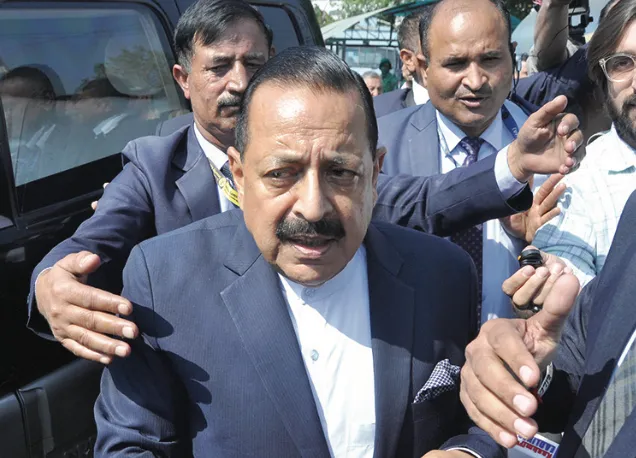
We believe in democracy, not horse-trading: Jitendra Singh

0
We believe in democracy, not horse-trading: Jitendra Singh

Srinagar, Oct 13:: Union Minister of State in the Prime Minister’s Office, Dr Jitendra Singh, on Monday ruled out the use of any “unfair means” by the Bharatiya Janata Party (BJP) in the upcoming Rajya Sabha elections in Jammu and Kashmir. He called on legislators to vote with their conscience, asserting that the Union Territory’s future is safest under the BJP leadership of Prime Minister Narendra Modi.

Dr Singh made these remarks while addressing reporters in Srinagar after accompanying the BJP’s three candidates — Sat Sharma, Ali Mohammad Mir, and Rakesh Mahajan — who formally submitted their nomination papers for the 24 October elections to four Rajya Sabha seats from J&K.

Dismissing speculations of inducements or cross-voting, Dr Singh said, “It is wrong to suggest that the BJP will incite cross-voting or indulge in buying votes. Ours is a democratic party, rooted in democratic values. We neither practice nor promote unethical tactics.”

He stressed that the party’s approach would be principled, relying on the merit of its candidates and the record of governance under Prime Minister Modi to appeal to the elected legislators of the J&K Assembly.

Dr Singh appealed directly to non-BJP MLAs, urging them to rise above party lines and consider the larger interests of the Union Territory. “If MLAs listen to their conscience, it will tell them that the future of Jammu and Kashmir is safe in the hands of the BJP,” he said. “We believe legislators will choose leaders who are experienced, sincere, and committed to public service — qualities embodied by our candidates.”

He highlighted that the Rajya Sabha polls are not bound by a party whip, giving MLAs the freedom to vote as they see fit.

The BJP has fielded three candidates for the four available seats — a bold move given the party’s numerical disadvantage in the 88-member legislative assembly, where it holds 28 seats.

“Our candidates — Sat Sharma, Ali Mohammad Mir, and Rakesh Mahajan — are seasoned leaders who have spent decades in public life. They represent the aspirations of various communities across Jammu and Kashmir,” Singh said. “They will be the strongest voices for the Union Territory in the Upper House of Parliament.”

The Union Minister also invoked Prime Minister Modi’s personal commitment to J&K, recalling symbolic and developmental gestures reflecting his engagement with the region. “Even after the devastating floods of 2014, it was in Jammu and Kashmir that Prime Minister Modi spent his first Diwali as PM,” Singh noted. He cited a series of development projects, infrastructure investments, and security reforms introduced in the region since 2014 as reasons why the BJP deserves broader support.

“In the last 11 years, the Prime Minister has given J&K the highest priority — from roads to railways, from education to employment, from grassroots democracy to ending corruption. Strengthening the BJP’s presence in the Rajya Sabha will ensure these efforts continue and are represented robustly in Parliament,” he added.

Greater Kashmir

DPS Budgam wins Late Roop Singh Memorial Cricket Trophy

0
DPS Budgam wins Late Roop Singh Memorial Cricket Trophy

Budgam, Oct 13: Delhi Public School (DPS) Budgam clinched the Late Roop Singh Memorial Cricket Trophy after defeating Islamia Hanfia High School, Soura, in a thrilling 10-over final at Woodland School.

As per a statement issued on Monday, batting first in the 10-over match, DPS Budgam set a competitive target of 80 runs. Their disciplined bowling attack then dismantled the opposition, bowling out Islamia Hanfia High School for just 37 runs, securing a comprehensive win. The star of the day was Huzaif Ajaz, a student of Class 10-B, who delivered a spectacular all-round performance.

Huzaif was adjudged Best Batsman and Best Bowler and was also honoured as the Man of the Series for his outstanding contributions throughout the tournament. Coach Bilal Ahmad received the Best Coach and Team Discipline awards of 2025. The victory marks a proud moment for DPS Budgam, highlighting the school’s growing reputation in sports, especially cricket.

The school in a congratulatory message said, “Congratulations to the entire team for their hard work and sportsmanship.”


Greater Kashmir

Won’t be part of campaigning for NC in Budgam: MP Ruhullah

0
Won't be part of campaigning for NC in Budgam: MP Ruhullah

Srinagar, Oct 13: Citing the incomplete fulfillment of promises and commitment to uphold his principles over political expediency, MP Srinagar and National Conference leader Agha Ruhullah on Monday said that he will not take part in campaigning for the party in the upcoming Budgam Assembly bypolls.

Ruhullah said that while the party will ultimately decide on the candidate, he sees no reason to actively campaign under the current circumstances.

He added that his engagement with voters has always been guided by trust, accountability, and the delivery of commitments rather than party pressure.

Ruhullah, who has represented the Budgam Assembly constituency multiple times and has a long-standing history with the National Conference, expressed disappointment that promises made during the last Assembly tenure have not been implemented.

“If the party wants me to go in front of people, there are a few points I want to see immediately. Only after that will I consider my participation,” he said, adding that his decision is based on principle and not political strategy.

Recalling his previous election campaigns, Ruhullah said his responsibility was always towards the institution he worked for and the people who trusted him with their votes.

Ruhullah questioned the party about follow-up actions on prior commitments, including the manifesto and other promises to constituents. “I asked them, what work did you do on the Assembly? What commitments did you make for yourselves? Until these are addressed, why should I go in front of people?” he said.

On speculation regarding NC fielding outsider on Budgam assembly seat, Ruhullah said that he will exercise his right as a voter independently. “Whoever wants to contest from here, let them contest. I have a vote. I am the owner of my vote. I will make my decision and work with the people,” he said, adding that his commitment is to letting constituents decide their representatives rather than blindly following party directions.

Ruhullah also said that the conditions under which he might reconsider campaigning are concrete action on issues like Cabinet decisions on reservation and fulfillment of commitments made to the constituency.

“If I see serious intention from the party to act on these issues, then I will evaluate my participation. Until then, I cannot involve myself in any campaign,” he added.

He also said that his political principles and ideological commitments have always guided his actions. “I have followed the principles of politics. That is what I want to do. I do not want to break my principles and break my commitments. I promised people that I would support them only if commitments made were honored. I will not leave that promise for anyone,” Ruhullah said.

Speaking on the autonomy of voters in Budgam, Ruhullah said that they are the true owners of their votes. While he may provide advice if asked, he will not dictate or influence voting decisions, he added. (KNS)

Greater Kashmir

Living hostages, Palestinian prisoners released as part of ceasefire in Gaza

0
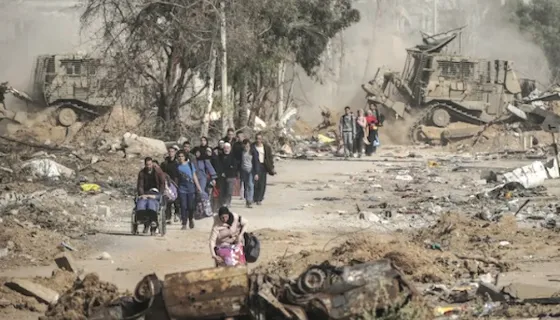
Israeli airstrikes, shooting kill 82 Palestinians in Gaza: Authorities

Deir Al-Balah (Gaza Strip), Oct 13: All 20 remaining living hostages held in Gaza and hundreds of Palestinian prisoners held by Israel walked free Monday as part of a ceasefire pausing two years of war that decimated the Gaza Strip and killed tens of thousands of Palestinians.

Hamas said Monday that it will release the bodies of four of the 28 deceased Israeli captives, though it was not immediately clear when the rest of the bodies would be sent back to Israel. Israel says it has released more than 1,900 Palestinian prisoners as part of the Gaza ceasefire deal.

Speaking to parliament, Israeli Prime Minister Benjamin Netanyahu declared he was “committed to this peace,” raising hopes that the ruinous war, which triggered other conflicts in the Middle East and had left scores of captives in militant hands, might come to an end. But fundamental questions remain over when and how.

Cheering crowds greeted buses of released prisoners in the West Bank and Gaza, while families and friends of the hostages gathered in a square in Tel Aviv, Israel, cried out with joy and relief as news arrived that the captives were free.

US President Donald Trump flew to the region and addressed the Knesset, the Israeli parliament. He was later to head to Egypt for a summit to discuss the US-proposed deal and postwar plans with other leaders.

Speaking ahead of Trump’s address in the Knesset, Netanyahu pledged that he was “committed to this peace.”

He added: “Today, the Jewish calendar marks the end of two years of war.”

While major questions remain about the future of Hamas and Gaza, the exchange of hostages and prisoners raised hopes for ending the deadliest war ever between Israel and the militant group. The ceasefire is also expected to see a surge of humanitarian aid into Gaza, parts of which are experiencing famine.

The war began when Hamas-led militants launched a surprise attack on southern Israel on Oct. 7, 2023, in which some 1,200 people, mostly civilians, were killed and 251 taken hostage.

In Israel’s ensuing offensive, more than 67,000 Palestinians have been killed, according to Gaza’s Health Ministry, which doesn’t differentiate between civilians and combatants but says around half the dead were women and children. The ministry is part of the Hamas-run government, and the UN and many independent experts consider its figures the most reliable estimate of wartime casualties.

The toll is expected to grow as bodies are pulled from rubble previously made inaccessible by fighting.

The war has destroyed large swaths of Gaza and displaced about 90 per cent of its some 2 million residents. It has also triggered other conflicts in the region, sparked worldwide protests and led to allegations of genocide that Israel denies.

“Much of Gaza is a wasteland,” UN humanitarian chief Tom Fletcher told the AP on Sunday.

Hostages and prisoners released

Tens of thousands of Israelis watched the hostage transfers at public screenings across the country. In Tel Aviv, families and friends of the hostages broke into wild cheers as television channels announced that the first group was in the hands of the Red Cross.

The freed hostages, all men, were later reunited with their families, and footage released by Israeli authorities showed tearful reunions.

The bodies of the remaining 28 dead hostages are also to be handed over as part of the deal, although the exact timing remained unclear.

Palestinians in the occupied West Bank rejoiced as buses carrying dozens of released prisoners from Ofer Prison arrived in Beitunia, near Ramallah, as Israel began releasing more than 1,900 prisoners and detainees as part of the ceasefire deal.

Later, giant crowds gathered to greet buses carrying other prisoners arriving at Nasser Hospital in Gaza’s southern city of Khan Younis.

The prisoners include 250 people serving life sentences for convictions in attacks on Israelis, in addition to 1,700 seized from Gaza during the war and held without charge. They will be returned to the West Bank or Gaza or sent into exile.

More than 150 prisoners were sent to Egypt by Israel and arrived at Gaza’s Rafah crossing with Egypt early Monday afternoon, according to an Egyptian official, who had direct knowledge of the deal’s implementation. He spoke on condition of anonymity because he was not authorised to brief the media.

Meanwhile, the Hostages Family Forum, a grassroots organisation representing many of the hostage families, said four bodies were expected to return to Israel on Monday. The group said it was “shocked and dismayed” that so few were coming back.

An international task force will work to locate deceased hostages who are not returned within 72 hours, said Gal Hirsch, Israel’s coordinator for the hostages and the missing.

A painful chapter

The hostages’ return caps a painful chapter for Israel. Since they were captured in the attack that ignited the war, newscasts have marked their days in captivity, and Israelis have worn yellow pins and ribbons in solidarity. Tens of thousands have joined their families in weekly demonstrations calling for their release.

As the war dragged on, demonstrators accused Netanyahu of dragging his feet for political purposes, even as he accused Hamas of intransigence. Last week, under heavy international pressure and increasing isolation for Israel, the bitter enemies agreed to the ceasefire.

Trump in Israel and Egypt

In his Knesset speech, Trump told Israeli lawmakers their country had no more to achieve on the battlefield and must work toward peace after two years of war against Hamas and conflicts with Hezbollah and Iran.

“Generations from now, this will be remembered as the moment that everything began to change,” he declared.

“Israel, with our help, has won all that they can by force of arms,” Trump said. “Now it is time to translate these victories against terrorists on the battlefield into the ultimate prize of peace and prosperity for the entire Middle East.”

His speech was briefly interrupted when two members of the Knesset staged a protest and were subsequently removed from the chamber. One held up a small sign reading, “Recognise Palestine.”

Despite the optimism expressed by Trump, many thorny questions remain. Among the most difficult is Israel’s insistence that a weakened Hamas disarm. Hamas refuses to do that and wants to ensure Israel pulls its troops completely out of Gaza.

So far, the Israeli military has withdrawn from much of Gaza City, the southern city of Khan Younis and other areas. Troops remain in most of the southern city of Rafah, towns of Gaza’s far north, and the wide strip along the length of Gaza’s border with Israel.

The future governance of Gaza also remains unclear. Under the US plan, an international body will govern the territory, overseeing Palestinian technocrats running day-to-day affairs. Hamas has said that Gaza’s government should be worked out among Palestinians.

Later Monday, Trump will head to Egypt, where he and Egyptian President Abdel-Fattah el-Sissi will lead a summit with leaders from more than 20 countries on the future of Gaza and the broader Middle East.

Palestinian leader Mahmoud Abbas arrived in Egypt’s Sharm el-Sheikh resort town to attend the meeting.

The plan envisions an eventual role for Abbas’ Palestinian Authority — something Netanyahu has long opposed. But it requires the authority, which administers parts of the West Bank, to undergo a sweeping reform program that could take years.

The plan also calls for an Arab-led international security force in Gaza, along with Palestinian police trained by Egypt and Jordan. It said Israeli forces would leave areas as those forces deploy. About 200 US troops are now in Israel to monitor the ceasefire.

The plan also mentions the possibility of a future Palestinian state, another nonstarter for Netanyahu.

Greater Kashmir

Cop injured after service rifle goes off accidentally in Jammu

0
Social media handler detained for spreading false narrative regarding Bandipora encounter: Police

Jammu, Oct 13: A Head Constable (HC) of Jammu and Kashmir Police (JKP) Monday sustained injuries in an accidental firing incident at Gulshan Ground in Gandhi Nagar, Jammu.

Mishap occurred when the police official was cleaning his service rifle.

He was rushed to Government Medical College (GMC) hospital, Jammu where he was stated to be stable after treatment.

A Police spokesperson said, “One Policeman identified as HC Sanjeev Kumar (Belt no 1059/SDRF 2nd battalion) Gulshan Ground Gandhi Nagar was injured today, October 13, 2025 in an accidental fire from his service rifle while cleaning it (service rifle) during duty at Gulshan Ground, Jammu.”

“The policeman has been shifted to GMC Jammu for treatment and is stable,” spokesperson said.

Greater Kashmir

Lieutenant Governor chairs 36th meeting of Executive Council of SMVD University

0
Lieutenant Governor chairs 36th meeting of Executive Council of SMVD University

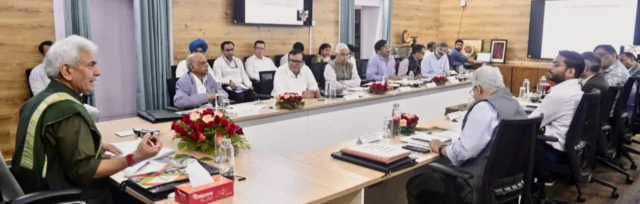
Jammu, Oct 13: Lieutenant Governor Manoj Sinha chaired the 36th meeting of Executive Council of Shri Mata Vaishno Devi University, at Raj Bhawan today.

The meeting was attended by Prof. (Dr.) Pragati Kumar, Vice Chancellor, SMVDU; Prof. Umesh Rai, Vice Chancellor Jammu University; Prof. Nilofer Khan, Vice Chancellor Kashmir University; Prof. Pankaj Chandra, Vice Chancellor and Chairman, Board of Management, Ahmedabad University; Prof. A.S.K. Sinha, Director, Rajiv Gandhi Institute of Petroleum Technology, Amethi; Prof. Manoj Singh Gaur, Director, IIT, Jammu; Dr. Mandeep K. Bhandari, Principal Secretary to Lieutenant Governor; Sachin Kumar Vaishya, CEO, SMVDSB; Ajay Kumar Sharma, Registrar, SMVDU and other members of Executive Council.

The Executive Council discussed several important academic and administrative issues and gave in-principle approval to various agenda points presented during the meeting.

The Lieutenant Governor directed the University to take a comprehensive review of the various important initiatives and programmes to regularly update the curriculum to meet the objectives of National Education Policy-2020 and transforming SMVDU into a premier educational institute at the National level.

He highlighted the need for a dedicated focus on lifelong learning skill and community engagement, increasing enrolment, industry collaboration and networking, Skill enhancement through short term courses, research, innovation and incubation, patents, strengthening of faculty and staff, and the introduction of new programs from the upcoming academic year.

The Lieutenant Governor directed the University to establish a specialized faculty for languages to offer integrated courses in Hindi, Dogri, French, and German. He emphasized on encouraging students enrolled in foreign languages and technical courses to also pursue Hindi and Dogri languages.

He also instructed the SMVDU to implement the complete digitalization of all University records.

The meeting also reviewed the ongoing projects and construction works in the University, implementation of NEP-2020, important matters pertaining to admissions, recruitment, faculty career advancement, non-functional promotions for non-teaching staff, end to end digitisation of student life cycle management process and utilization of e-Samarth dashboard.

The chair was informed that the university has now been designated as a ‘TCS Priority College’ by Tata Consultancy Services for a period of three years as part of their campus placement program.

Prof. (Dr.) Pragati Kumar, Vice Chancellor, Shri Mata Vaishno Devi University presented various Agenda items before the Executive Council for approval and ratification.

Greater Kashmir

- Advertisement -
Google search engine

Recent Posts