
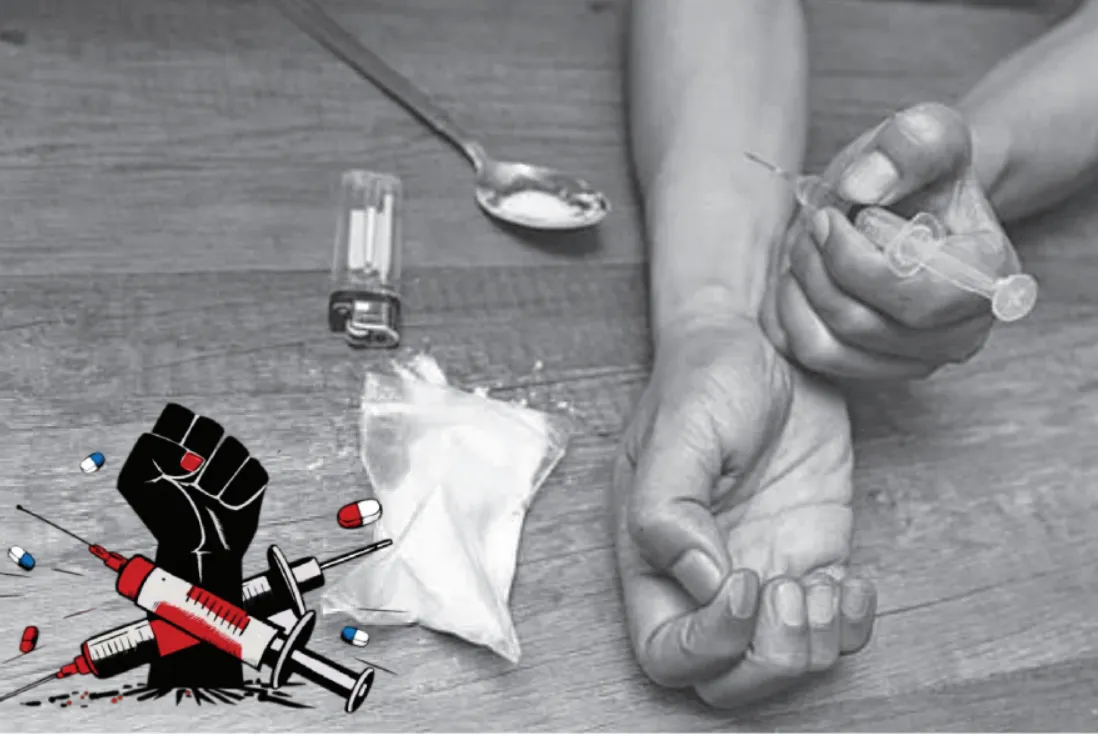
Srinagar, Sept 23: Jammu and Kashmir Police intensified their operations against the narcotics trade and drug abuse in 2025, registering dozens of cases, arresting peddlers, and destroying illicit cultivation across the Union Territory. Officials said the year has seen a multi-pronged campaign involving law enforcement, excise, and agriculture departments, and locals in a collective attempt to curb the menace that has emerged as one of the most serious social challenges in the region.
According to official figures, more than ctrade have been registered since 2023, with 4,536 individuals arrested. The trend has continued into 2025, with regular seizures, arrests, and crop destruction reported from both Jammu and Kashmir divisions.
In Sopore, police arrested four drug peddlers earlier this year as part of a targeted drive to break local supply chains. In Budgam, the Anti-Narcotics Task Force (ANTF) seized a large cache of poppy straw in an operation described by officials as one of the most significant hauls of recent months. In Handwara, police detained a notorious habitual peddler, Farooq Ahmad Dar alias “Jungli,” under the PIT NDPS Act, citing his repeated involvement in drug-related activities.
Simultaneously, authorities intensified their drive against cannabis cultivation, locally known as “bhung.” In districts such as Anantnag, Ganderbal and Baramulla, teams of police, excise, revenue and agriculture officials have destroyed wild cannabis patches and crops cultivated on private lands. “The message is clear: there will be no tolerance for narcotics cultivation or trade. Our teams are working in close coordination to ensure no such activity goes unchecked,” a senior police officer in Srinagar told the news agency Kashmir News Trust.
Officials said the campaign is not limited to policing alone but also involves cooperation from locals. In many cases, information from villagers has led to successful operations. In Rajouri’s Wagoora area, for example, police arrested a man after he was found cultivating cannabis in the yard of his house. The crop was destroyed on the spot and a case registered under the NDPS Act.
Seizures have also been made in urban areas. In June, Jammu police arrested two individuals and recovered 350 grams of opium from their possession. In Srinagar and adjoining districts, police have stepped up naka checks to intercept drug consignments being moved along highways and feeder roads.
The spread of narcotic abuse, particularly among youth, has been described by police as a grave social threat. Senior officers have repeatedly stressed that while law enforcement is working to choke supply lines, efforts must also focus on reducing demand through awareness campaigns and rehabilitation. “The fight against drugs cannot be won by arrests alone. It requires a combination of strict enforcement, community participation, and treatment for addicts. Every family must play a role,” said an officer associated with the anti-narcotics campaign.
Officials acknowledge that the profitability of narcotics trade continues to draw cultivators and peddlers. The use of wild cannabis and smuggling of poppy derivatives persist in certain pockets, while cross-border trafficking routes also pose risks. “The trade is lucrative, and unless there is constant vigilance, new networks keep emerging. That is why sustained action is essential,” said a police official in north Kashmir.
Legal experts point out that stringent provisions of the NDPS Act are being increasingly invoked to ensure deterrence. Convictions under the law can lead to long prison terms and heavy fines, depending on the quantity and intent. However, they caution that alongside punitive measures, rehabilitation opportunities must be expanded for those caught in the cycle of addiction.


