Home Blog Page 578

ASI after collapse incident near monument in Delhi

0
ASI after collapse incident near monument in Delhi

New Delhi, Aug 15: The Archaeological Survey of India on Friday said the Humayun’s Tomb, part of a UNESCO World Heritage Site, is in “perfect condition”, and clarified that reports about a collapse incident in south Delhi does not pertain to the monument.

The ASI said it regrets the “unfortunate” incident at “an unprotected structure”, abutting the 16th-century monument.

Five people were killed and four others injured on Friday evening after a wall of a dargah near the Humayun’s Tomb in Delhi’s Nizamuddin area collapsed, police said.

A total of nine injured people were sent to AIIMS Trauma Centre and one was rushed to LNJP Hospital, they said.

There were initial reports claiming there was a “collapse of a portion of a dome” at the tomb.

In a post on X, the ASI wrote, “The unfortunate incident, in the Patte Shah Dargah, at Nizamuddin area of Delhi, is deeply condoled.”

“The Archaeological Survey of India regrets the unfortunate incident, at an unprotected structure, abutting the WH monument of the Humayun’s Tomb but due to the nearness to the site could reach out as aides to those trapped in the accident,” it said.

“The WH monument of the Humayun’s Tomb is in perfect condition and this news does not pertain to the monument,” the ASI posted.

Humayun’s Tomb is a major tourist attraction in the national capital and is visited daily by hundreds of domestic and foreign visitors.

The Humayun’s Tomb complex, which consists of the central tomb and other structures and landscaped elements in Nizamuddin area, is an ASI-protected site.

“Humayun’s Tomb stands within a complex of 27.04 ha that includes other contemporary, 16th century Mughal garden-tombs such as Nila Gumbad, Isa Khan, Bu Halima, Afsarwala, Barber’s Tomb and the complex where the craftsmen employed for the building of Humayun’s Tomb stayed, the Arab Serai,” according to the UNESCO website.

It was inscribed on the UNESCO list in 1993, with a minor boundary modification which was inscribed in 2016, it says.

Greater Kashmir

Five dead after wall of dargah near Humayun’s Tomb collapses: Delhi Police

0
Social media handler detained for spreading false narrative regarding Bandipora encounter: Police

New Delhi, Aug 15: Five people were killed and four others injured on Friday evening after a wall of a dargah near the Humayun’s Tomb in Delhi’s Nizamuddin area collapsed, police said.

A total of nine injured people were sent to AIIMS Trauma Centre and one was rushed to LNJP Hospital, they said.

” So far, we have learned that five people who were under treatment at AIIMS trauma Centre died and others are still under treatment. We have cordoned off the area,” Joint Commissioner of police Sanjay Kumar Jain told reporters.

He said that the people were visiting the dargah for Friday prayers and were sitting inside the room due to rain when the incident took place.

The rescue operation is completed, the police said, adding a total of 10 to 12 victims were rescued from the debris after a call regarding the incident was received at 3.55 PM.

Multiple rescue agencies, including the Delhi Fire Services (DFS), Delhi Police, NDRF and Delhi Disaster Management Authority (DDMA), were pressed into service following the incident.

“The Station House Officer and local staff reached there within five minutes and started the rescue. Some time later, fire personnel and CATS ambulances also reached the spot. NDRF also joined the rescue efforts,” a senior police officer said, adding that the rescue operations are still going on.

A senior DFS official had initially said that a call regarding the collapse of a portion of a dome at the tomb was received after which five fire tenders were rushed to the spot immediately.

Authorities clarified that the incident did not involve the main dome of the 16th-century monument but a smaller room within its premises.

Vishal Kumar, an eyewitness, told PTI, “I work at Humayun Tomb. When we heard the noise, my supervisor came running. We called for people and the administration. Slowly, we took out the people who were trapped.”

“There were at least 10 to 12 people. The Imam was also there and he is also among the injured. I have taken out atleast eight to nine people,” he said.

A female eyewitness said, “I was standing outside and was about to enter the room and was just two steps away from it. As it started raining, everyone went inside to take shelter.”

“Just then, the wall collapsed. After that, I started shouting for help, but there was no one around. I kept shouting, and then some people from nearby came and helped us rescue everyone trapped inside,” she told PTI.

Humayun’s Tomb, a UNESCO World Heritage Site, is a major tourist attraction in the national capital and is visited daily by hundreds of domestic and foreign visitors.

“There has been no damage in Humayun Tomb. A new structure was being built near the Humayun tomb, its portion has collapsed, and some of it also fell onto the walls of the Humayun Tomb,” Ratish Nanda, conservation architect at Aga Khan Trust for Culture (AKTC), the organisation behind the restoration of Humayun’s Tomb, said.

The Humayun’s Tomb complex has been the site of a long-standing partnership between the Archaeological Survey of India and the Aga Khan Trust for Culture.

Greater Kashmir

Clear signs your diet is actually working

0
Morning drinks to naturally burn belly fat, boost metabolism

Srinagar, Aug 15: In today’s fast-paced world, whether in India or anywhere else, eating healthy can feel like a constant balancing act. Between busy schedules and tempting quick fixes, it’s easy to focus on food just for weight loss. But a truly effective diet does much more—it fuels how you feel, how you function, and how your body thrives.

Whether you’re a student needing brain-friendly meals, a professional navigating high-stress days, or a homemaker caring for your family’s wellbeing, the benefits of a balanced diet show up in everyday ways.

Here are simple, science-backed signs that your nutrition is actually working for you. No fancy tests needed—just honest observation and small, smart habits. If your gut’s happy, your mood is steady, and your energy levels feel just right, chances are, your diet’s doing its job.

You Have Steady Energy Levels Throughout the Day

A diet rich in complex carbs (whole grains, pulses) and proteins maintains blood sugar balance. High glycaemic foods cause erratic spikes and crashes, as is proved in a study published in 2019 in the peer-reviewed journal, Cureus.

Feel Full — Without the Urge to Binge

If you’re staying full for three to four hours after a meal and not constantly reaching for snacks, that’s a good sign your meals are well-balanced. It usually means you’re getting the right mix of fiber, healthy fats, and protein.

A 2012 guide, Essentials of Healthy Eating, recommends focusing on whole foods like unsaturated fats, whole grains, lean proteins, fruits, and vegetables—while keeping things like sugary drinks, refined carbs, and saturated fats to a minimum. For many women, this kind of eating pattern works especially well.

Digestion Is Smooth and Regular

Regular, easy bowel movements usually point to one thing: a fiber-rich, gut-friendly diet. If you’re eating enough fruits, vegetables, whole grains, and maybe even fermented foods, your digestive system tends to run like clockwork.

And here’s the bonus: a healthy gut supports a healthier brain, thanks to the gut-brain connection. So better digestion might also mean a better mood and sharper thinking.

 Maintaining a Healthy Weight — Without Extreme Dieting

If your weight has stayed fairly stable for the past six months or more, without relying on crash diets or detox plans, that’s a strong sign your eating habits are on point.

Balanced eating isn’t about extremes—it’s about consistency. According to WHO, a good diet is adequate, diverse, balanced, and moderate. If you’re managing your weight naturally with everyday meals, you’re likely doing it right.

Mind Feels Clear, and Your Mood Stays Steady

Feeling mentally sharp and emotionally balanced (even during hormonal shifts like menstruation) often reflects a well-nourished body. The brain needs key nutrients like omega-3 fatty acids, complex carbohydrates, and antioxidants to function at its best.

If you’re not dealing with wild mood swings or brain fog, your diet is probably giving your brain exactly what it needs.

Glowing Skin, Healthy Hair

Vitamins A, C, E, protein, and hydration reflect in skin and hair health. Studies mentioned above link whole-food diets with better “appearance” outcomes. So, if you have clear, glowing skin and hair that isn’t suffering from dandruff, dryness, brittleness-and has a natural shine-then it is likely that you are getting enough vitamins, proteins and water.


Greater Kashmir

Upcoming GST reforms and what they mean for you : Details

0
Upcoming GST reforms and what they mean for you : Details

Srinagar, Aug 15: India is set to undergo significant reforms in its Goods and Services Tax (GST) regime this year. Described as “next-generation” changes, these reforms are expected to be rolled out before Diwali, Prime Minister Narendra Modi announced on Independence Day. He assured that the new measures would lead to a substantial reduction in taxes on commonly used items, easing the financial burden on consumers.

The Centre has already prepared a three-pillar blueprint for these reforms, which has been sent to the Group of Ministers (GoM) for consultation. The final proposals are likely to be taken up in the upcoming meeting of the GST Council.

During his Independence Day address from the Red Fort, PM Modi framed the reforms as a “Diwali gift” for the public, promising relief through lower tax rates across the country. The GST system, which was implemented on July 1, 2017, has now completed eight years. The Prime Minister noted that it was time for a comprehensive review. A high-level committee was formed to assess the system and consult with states, paving the way for the proposed changes.

“These reforms will substantially reduce taxes on goods used by the common man,” said PM Modi. “Our MSMEs will benefit greatly, and the reduced cost of daily-use items will also help strengthen the overall economy.”

The proposed reforms are built around three key pillars: structural reforms, rate rationalisation, and ease of living. These align with the government’s broader vision of making India “atmanirbhar” (self-reliant) and aspiring to become the world’s third-largest economy.

The Centre has assured that it will make every effort to facilitate early implementation of the reforms. “The government reaffirms its commitment to evolving the GST into a simple, stable, and transparent tax system – one that supports inclusive growth, strengthens the formal economy, and enhances ease of doing business across the country,” the government said.

The first pillar, structural reforms, aims to address sector-specific issues such as the inverted duty structure, which currently causes imbalances in input and output tax rates. It also seeks to resolve classification disputes and bring stability and predictability to the GST framework.

The second pillar focuses on rate rationalisation. This involves reducing GST rates on essential and aspirational items, simplifying the rate structure, and gradually moving towards fewer tax slabs. The goal is to make the system more consistent and easier to navigate.

The third pillar, ease of living and compliance, is intended to simplify tax processes, particularly for startups and small businesses. Measures include the introduction of pre-filled returns, streamlined registration, and a faster refund mechanism, making GST compliance less burdensome.

According to the Finance Ministry, these reforms are rooted in cooperative federalism and are expected to strengthen key sectors of the economy. By correcting the inverted duty structure, the reforms aim to align input and output tax rates, reduce the accumulation of input tax credit, and encourage domestic value addition. Resolving classification issues will further simplify compliance, reduce disputes, and provide consistency across industries.


Greater Kashmir

M Raju given additional charge of Divisional Commissioner Kashmir

0
Govt forms committee to frame policy for repair, renovation of pre-2002 structures near Dal Lake

Srinagar, Aug 15: The Jammu and Kashmir Government has assigned additional charge of Divisional Commissioner Kashmir to M. Raju, IAS (AGMUT: 2005), Commissioner/Secretary to the Government, General Administration Department, who is also holding additional charge of Administrative Secretary, Information Department.

As per government order as, Raju will hold the post until Anshul Garg, IAS (AGMUT: 2013) assumes charge.

The order, issued in the interest of administration, was signed by M. Raju in his capacity as Commissioner/Secretary to the Government.

Greater Kashmir

Will Pahalgam killers decide whether JK will be a state, asks CM Omar Abdullah

0
Will Pahalgam killers decide whether JK will be a state, asks CM Omar Abdullah

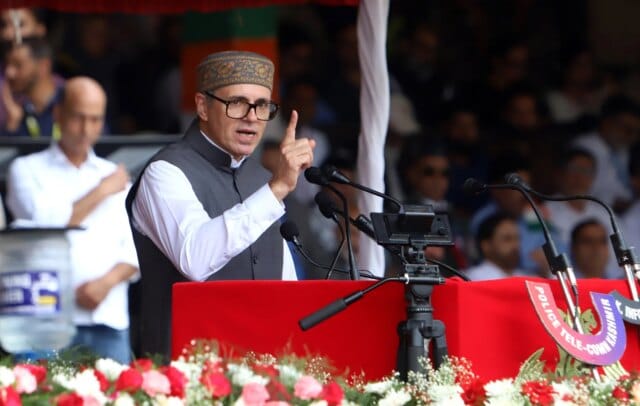
Srinagar, Aug 15: Chief Minister Omar Abdullah on Friday delivered a forceful Independence Day speech, criticising the practice of linking terror attacks to Jammu and Kashmir’s political future and asserting that Pakistan should not be allowed to influence it through terrorism.

In his first speech since Jammu and Kashmir was downgraded to a union territory, he announced a signature campaign would be launched to press the demand for restoration of statehood.

Abdullah’s remarks came a day after a Supreme Court bench, led by Chief Justice of India B R Gavai, said “incidents like Pahalgam” must be considered when deciding on statehood.

Pakistani terrorists killed 26 civilians, mostly tourists, in the Baisaran meadow in south Kashmir’s Pahalgam on April 22.

In his speech at Bakshi Stadium here, Abdullah termed the reference to Pahalgam “unfortunate” and directly challenged the idea of letting terror dictate the region’s political future.

He said, “Will the killers of Pahalgam and their masters in the neighbouring country decide whether we will be a state?”

“Every time we are close to statehood, they will do something to sabotage it. Is this fair? Why are we being punished for a crime in which we had no role?” the chief minister questioned, pointing that residents from Kathua to Kupwara protested the Pahalgam attack on their own will.

Abdullah asserted that successive governments in Jammu and Kashmir progressively brought down militancy.

“Elected government, whether mine or of others, did not allow such incidents. We had brought down the militancy-related parameters every year. Today it is said that we cannot handle the situation. We have not failed earlier and we will not fail in future as well. You will have to trust us,” he said.

To fight the recent legal and political setbacks, the chief minister announced a plan to take the people’s voice directly to Delhi. “The Supreme Court has given us eight weeks,” he said, referring to the time granted by the apex court before the next hearing on the statehood issue.

“Me and my colleagues will use these eight weeks to go to each of the 90 assembly constituencies of Jammu and Kashmir.”

As part of this door-to-door campaign, he said, people will be asked for their signatures or thumb impressions to answer a single question — “Do you want to make Jammu and Kashmir a state again or not?”

He promised to obtain signatures from lakhs of people and submit them before the central government and the Supreme Court as a clear public mandate.

An emotional Abdullah, while admitting that he his political image has suffered due to dual power centres in Jammu and Kashmir, confessed that after much contemplation, he decided to speak from his heart in his inaugural Independence Day address instead of reading a scripted government speech.

“If I had read that, the people of Jammu and Kashmir would have thought that all is well. There is no question of change,” he said.

The CM also spoke about the fading hope for a major announcement from New Delhi regarding Jammu and Kashmir’s future. He said his well-wishers told him that he could expect a significant change, but admitted that his hope had begun to dim.

“We waited impatiently for that speech,” he said, referring to Prime Minister Narendra Modi’s address to the nation on Independence Day.

“I was even told that the documents are being prepared… We waited. It did not happen. The truth is that the ray of light have started to fade,” he said.

However, Abdullah insisted that he is not “helpless” and refused to accept the status quo.

In his speech, Abdullah reflected on the changes that have occurred over the last 11 years, since he last addressed the public from the same venue.

“When I was standing here 11 years ago, I was the chief minister of J&K state. In this country, we had our own identity, our own special status, our own flag, our own constitution. Today, none of that is left.”

Reflecting on his previous tenure from 2009 to 2014, Abdullah highlighted the significant differences between leading a state and a union territory.

“I am the only person in the whole world who can really tell the difference,” he said and described the current governance model as a system “not for success” but “for failure”.

The chief minister likened his government to a horse which has its front legs tied and is expected to gallop.

“It (the horse) may walk but it will not reach the destination as fast as expected,” he said, adding, “We have been given a government. There are powers in the government. But somewhere our hands are tied behind our backs.”

Taking on the bureaucracy, Abdullah said while the government is accountable to the assembly, and the assembly to the people, the bureaucracy is failing to answer to the elected government.

This breakdown disrupts the “triple chain of accountability” essential for a successful democratic government, he said.

Abdullah lamented that many of the cabinet’s decisions are being changed or stopped without its consent.

He questioned the point of having an elected government if it is not empowered to govern effectively. “What I regretfully say today is that we don’t have that power,” he said, emphasising that a “new Jammu and Kashmir” cannot be achieved without the full powers of statehood.

Despite the challenges, he said, he is not ready to accept the current situation and will not rest until justice is achieved. “We will get justice… and we will rest only after that by God’s will,” he said.

Greater Kashmir

Teenager found dead under mysterious circumstances in south Kashmir’s Kulgam

0
Teenager found dead under mysterious circumstances in south Kashmir's Kulgam

Kulgam, Aug 15: A 15-year-old boy was found dead at Jadipora village in south Kashmir’s Kulgam district under suspicious circumstances at his residence.

The deceased has been identified as Athar Subzar, son of Subzar Ahmad, a 10th-grade student. Family members said they were shocked to find him unresponsive at home, prompting neighbours to alert the authorities.

Police teams reached the spot soon after the incident was reported and took possession of the body. Officials said all legal formalities were completed and a medical examination was conducted before the mortal remains were handed over to the family for last rites.

Police have maintained that only the post-mortem report will reveal the facts. “We have initiated proceedings under law and are investigating the matter from all possible angles,” a police official told the news agency Kashmir News Trust.

The grieving family has urged the authorities to ensure a fair and transparent probe. [KNT]

Greater Kashmir

Survivors recount horror as flash floods kill 60, dozens rescued from debris

0
Search intensifies for survivors in cloudburst-hit village in J-K's Kishtwar

Chositi, Aug 15: Nine-year-old Devanshi was among the hundreds of pilgrims who had gathered here for the last leg of the yatra to Machail Mata temple when tragedy struck on Thursday. Buried under mud and debris when a Maggi-point shop was hit by flash floods, she emerged hours later, rescued by her uncle and other villagers.

“I couldn’t breathe. My uncle, bouji, and others removed wooden planks after hours, and we all came out. Mata saved us,” she says, the terror still vividly reflected in her voice.

Like her, 32-year-old Sneha is still in disbelief that she is alive. Moments after loading luggage onto their vehicle, she and her four family members were swept away in a roaring torrent, buried under mud and crushed beneath a vehicle.

“I was trapped in mud under a vehicle, surrounded by bodies – some of them children with broken necks and severed limbs. I lost hope of my survival,” she says. Somehow, they clawed their way out. At least 60 people lost their lives when a massive cloudburst led to flash floods in this remote mountain village in Jammu and Kashmir’s Kishtwar district.

Every survivor here carries a story about escaping from the very jaws of death.

“We stopped at a Maggi shop. People told us to run (because of the cloudburst), but we stayed back, thinking it was safe here,” Devanshi says, narrating her ordeal.

Within minutes, a large mass of mud collapsed over the shop. “Mata saved us,” she repeats as she recounts how her family members and villagers pulled her out of the debris.

She was taken to a hospital along with other family members, where she was given first aid.

Sneha from Jammu says she had felt it was all over for her after being washed away and buried under a vehicle. “As we reached our vehicles, we heard a loud bang and saw a cloudburst over the hill,” she recalled.

In no time, a wall of mud, boulders, and trees swept them towards the Chenab River, trapping them.

“My father managed to free himself first, then helped me out. I pulled my mother out from under an electric pole. She was barely conscious and badly injured,” she said.

She said some villagers were washed away into the Chenab. “Bodies lay everywhere. The entire hill had come down. Even the Thakur ji idol of Chittoo Mata Temple was washed away before our eyes.”

Sneha says the swift action of officials, police, the Army, CRPF, and locals saved countless lives. “Within an hour, vehicles arrived to take the injured to hospitals. If they had been late, many more would have died,” she said.

The sudden roar of water, the deafening blast, and the avalanche of mud, boulders, and trees turned Chositi village into a scene of unimaginable destruction within seconds. A cloudburst high above the hills triggered flash floods that swallowed homes, vehicles, and lives, leaving survivors in shock and grief.

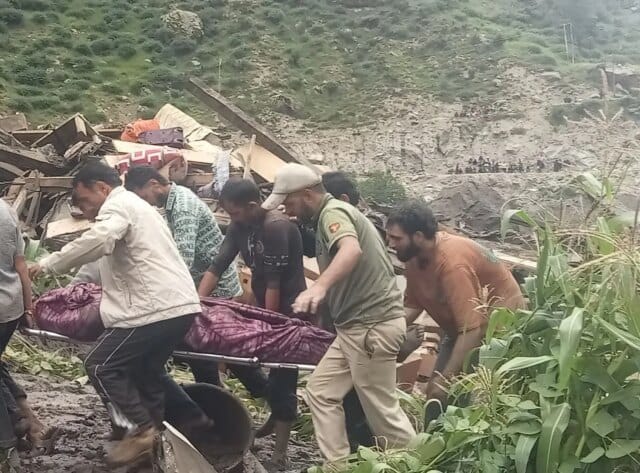
The shocking scenes of physical and psychological trauma unfolded on a massive scale as search and rescue operations were underway, digging out mud-buried bodies and rescuing the injured.

Sudhir from Udhampur was with a group of 12 when the “sky and earth seemed to collapse together”.

“After the blast sound, the whole area was filled with fog and dust,” he recalled. “Most of my group members were trapped in slush. My wife and daughter were buried under other people. At the bridge construction site, I saw dozens swept into the Chenab. It took seconds for the hill to bury everything.”

Blood-stained bodies, mud-filled lungs, shattered ribs, and deep wounds packed with stones — these are just some of the harrowing injuries sustained by people, including pilgrims and security personnel, caught in the aftermath of the catastrophic cloudburst in the foothill hamlet of Chositi.

Undergoing treatment at the hospital, Sunita Devi from Nanak Nagar said, “I was running when I fell, and some women fell on me. An electric pole hit me and I got a severe shock. I was looking for my son the whole time. We all survived… Mata Rani saved us.”

Others were not so fortunate. Uma from Jammu clung to a vehicle tyre to avoid being swept away. “A policeman saved me. But my sister, Gahna Raina, is still missing,” she said.

Vaishali Sharma, who was in a 15-member group, said they ran into a shop for shelter when told about the cloudburst.

“It was around 12:15 PM when we neared the bridge. We were told to run and took shelter in a shop, but it caved in under mud and boulders. I was caught between the rocks. I don’t know where my parents are. Thanks to the Army, I and five others were rescued.”

Rescuers, including personnel from the Army, police and CRPF and villagers, continued to pull out survivors and retrieve bodies late into the night. Officials said the quick response helped prevent a higher death toll.

Additional Superintendent of Police Pradeep Singh said all forces were engaged in the massive search-and-rescue effort. “SDRF, Army, CRPF, CISF, Police — everyone is on the ground”.

He said that locals too played a huge role, especially over 20 bikers led by Ganga Ram, who ferried injured people from Chositi to Hamori as the road was cut off by the flooded nallah. “Without them, more lives would have been lost.”

“This has been a battle against death,” a rescue worker said.

Greater Kashmir

J-K LG hoists national flag at Raj Bhavan in Srinagar on Independence Day

0
J-K LG hoists national flag at Raj Bhavan in Srinagar on Independence Day

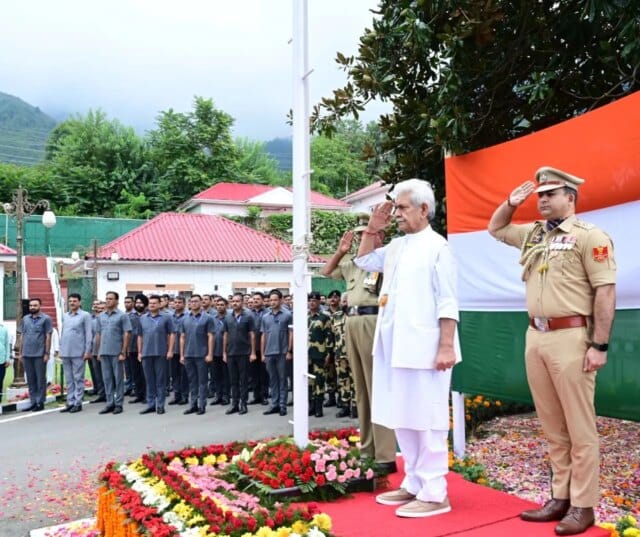
Srinagar, Aug 15: On the occasion of 79th Independence Day, Lieutenant Governor Manoj Sinha hoisted and saluted the National Flag at Raj Bhavan in Srinagar. He conveyed his heartiest greetings and good wishes to all.

The Lieutenant Governor paid tributes to the freedom fighters and brave hearts of Police, Army and CAPFs. He also paid homage to the citizens who lost their lives due to the tragic cloudburst in Chashoti, Kishtwar.

“On this Independence Day, let us take a pledge that no individual or village is left out of this historic journey of peace and progress. As we watch tricolour flying high, let us look ahead with pride, confidence and hope towards a better and brighter future for UT of Jammu Kashmir,” the Lieutenant Governor said.

In a post on X, the Lieutenant Governor said: “Hoisted our National Flag at Raj Bhavan in Srinagar on the occasion of 79th Independence Day. I convey my heartiest greetings and good wishes to all. This is a day we salute our tricolor and feel pride in watching it fly high in the sky.
I join every citizen in paying homage to our freedom fighters, whose undying love for Motherland secured us our freedom. I pay tribute to civilian martyrs, who were brutally killed by Pakistan-backed terrorists in Pahalgam on April 22.

I also thank our armed forces, our brave soldiers, security, intelligence agencies Jammu Kashmir Police and every personnel involved in ‘Operation Sindoor’ & ‘Operation Mahadev’ for their bravery and commitment to avenge the Pahalgam terror attack.

My heart also goes out to the families affected by cloudburst in Chashoti, Kishtwar. I am devastated by this natural calamity and express my condolences to the bereaved families. Relief Operations are underway on war footing.

It is our duty to wipe out every single terrorist from our sacred Motherland. While armed forces, CAPF and J&K Police are working with commitment to crush terrorism, the patriotic fervor and society’s collective effort will definitely make Jammu Kashmir terror-free.

We must work with one single aim, with one single purpose to make Jammu Kashmir strong and self-reliant in every sector. We must dedicate ourselves to attain the goal of equality and prosperity for all.

Let us rededicate ourselves to build a better life for our farmers, youth and women. Let us work towards building a prosperous rural economy and empower the working classes for societal transformation.

On this Independence Day, let us take a pledge that no individual or village is left out of this historic journey of peace and progress. As we watch tricolour flying high, let us look ahead with pride, confidence and hope towards a better and brighter future for UT of Jammu Kashmir.”

Greater Kashmir

CM Omar Abdullah pays floral tributes at Balidan Stambh

0
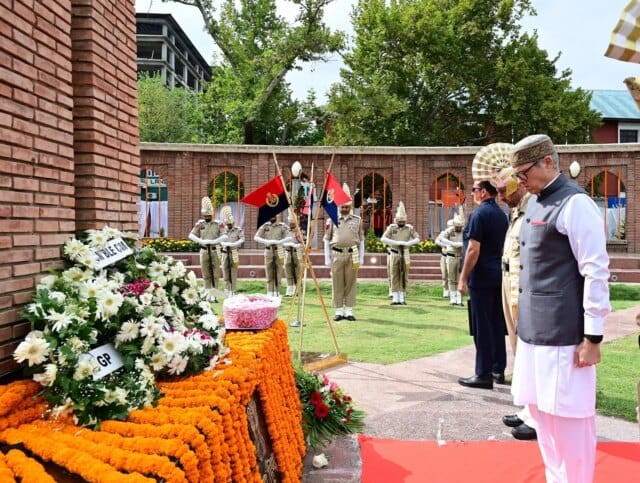
CM Omar Abdullah pays floral tributes at Balidan Stambh

Srinagar, Aug15: Chief Minister Omar Abdullah today paid floral tributes at the Balidan Stambh in Srinagar, honoring the supreme sacrifices of the martyrs.

Chief Minister Omar Abdullah laid a wreath at the memorial and observed a moment of silence as a mark of respect for those who laid down their lives in the service of the nation.

Director General of Police J&K Nalin Prabhat, Divisional Commissioner Kashmir, ADGP Headquarters, senior officers, security personnel, and others were also present.

Greater Kashmir

- Advertisement -
Google search engine

Recent Posts