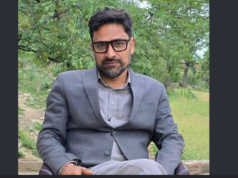
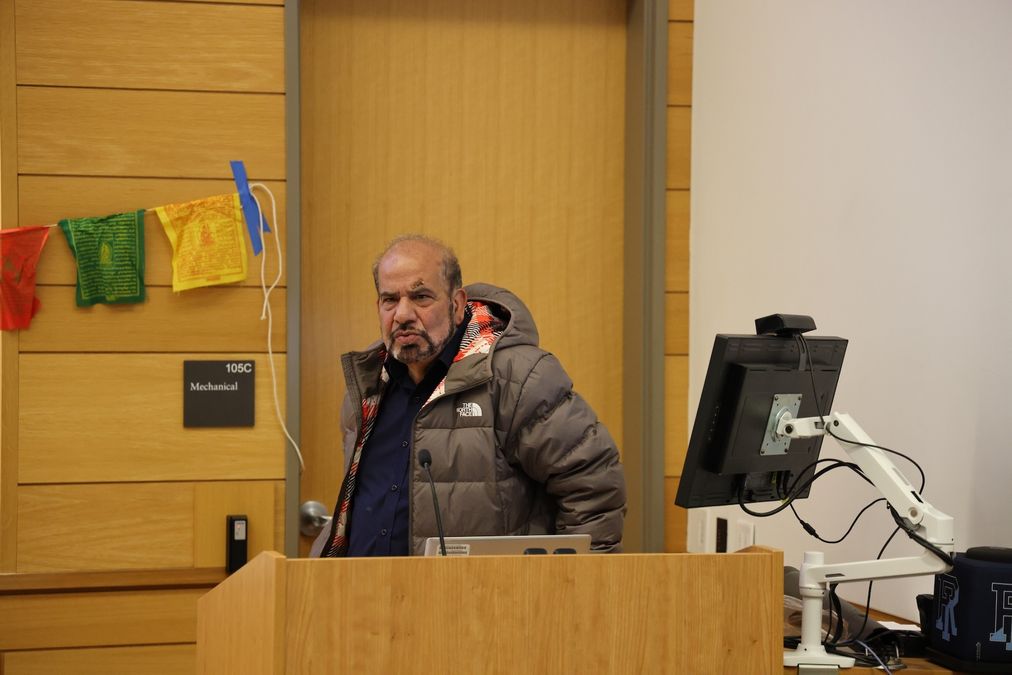
Srinagar, Nov 28: Kashmiri author and social activist Dr Khwaja Farooq Renzushah has highlighted the philosophical connections between Mahatma Gandhi’s concept of Ahimsa, Martin Luther King Jr’s vision of the “Beloved Community” and Kashmir’s Sufi-Rishi tradition while delivering a keynote address at an international conference on peace and non-violence at the University of Rhode Island, Kingston, in the United States.
In his address titled “Understanding Symphony of Humanity: Wisdom, Gandhian Jee Ahimsa, and the Kings’ Dream”, Renzushah, Chairman of Kings Humanity Wisdom Ahimsa Gandhian Achievement (KHWAGA), called for a renewed global commitment to humanity, compassion, equality and non-violence.
Addressing faculty members, scholars and students, he said Kashmir’s fourteenth-century Sufi and Rishi traditions had established a civilisational foundation rooted in love, pluralism and respect for human dignity.
Referring to Sufi and Rishi figures including Shah Bulbul Shah, Mir Syed Ali Hamdani, Sheikh-ul-Alam and Lal Ded, he said their spiritual teachings had shaped a society in which people of different religious backgrounds shared a common cultural and spiritual space.
He recalled that the shrine of Shah Bulbul Shah, which he described as Kashmir’s first khanqah, became a place where the poor were fed, the sick were cared for and the powerful were reminded of their responsibility to serve society with compassion.
Renzushah also referred to Sultana Kota Rani, whom he described as the Reshi Queen of Kashmir, saying her legacy represented moral courage and resistance against the historical threat posed by Mongol invaders.
He said the central message of Kashmir’s Sufi-Rishi tradition was that another human being should not be viewed as an enemy but as a reflection of the same divine existence.
Drawing parallels between Gandhi and Martin Luther King
Explaining the theme of his address, Renzushah discussed what he described as the ethical similarities between Martin Luther King Jr, Mahatma Gandhi and Kashmir’s spiritual traditions.
He said King’s concept of the “Beloved Community” envisioned a society in which prejudice and poverty could be overcome through love, while Gandhi’s Ahimsa represented active moral resistance rather than passive submission.
He described the Kashmiri Sufi-Rishi concept of “Ren” as a recognition of humanity as one family, emphasising that peace without justice remained incomplete and freedom without equality an unfulfilled promise.
Renzushah said Gandhi’s philosophy of human love and non-violence had parallels with the spiritual teachings of Kashmir’s Sufi saints, including Bulbul Shah, Mir Syed Ali Hamdani and Sheikh-ul-Alam.
He also referred to Gandhi’s visit to Kashmir during the communal violence of 1947, saying the Mahatma had drawn inspiration from the Valley’s Sufi shrines and spiritual traditions while advocating the protection of humanity.
He described the Gandhian approach as the transformation of politics into ethics and religion into compassion, adding that Martin Luther King Jr and his wife Coretta Scott King had demonstrated the practical significance of these ideals.
Warning against ideologies of hatred
Addressing the challenges confronting humanity, Renzushah spoke about what he described as ideologies of hatred, communalism, xenophobia, discrimination and violence.
Referring to his historical works, including Cashmere, Bear’s Throne and Sultana Kota Rani: Reshi Queen of Kashmir, he said the metaphor of the “Bear’s Throne” represented tyranny, fear and the forces that use divisions to exercise control over people.
He said such forces manufactured conflicts based on religion, sect, caste, colour, region, geography and other identities.
According to him, scholars had a responsibility to understand and expose the mechanisms of oppression rather than remain indifferent to injustice.
He said the sacrifices made by Gandhi and Martin Luther King Jr demonstrated the importance of standing for peace, humanity and non-violence.
Renzushah also identified communalism, xenophobia, the global arms trade, environmental destruction and the misuse of digital platforms to silence compassionate voices as contemporary challenges to humanity.
He said the framework of King’s philosophy and Gandhi’s Ahimsa could provide a moral response to these challenges.
Kashmir’s composite cultural heritage
Referring to Kashmir’s composite cultural traditions, Renzushah said the Valley had numerous symbols reflecting the coexistence of different faiths and spiritual practices.
He mentioned Shankaracharya, Makhdoom Sahib and Sharika Devi, whose religious and spiritual associations with the Valley, he said, reflected a shared cultural heritage.
He also referred to Rozabal, describing it as a site surrounded by different spiritual and historical narratives. His address included references to claims linking the site to Jesus and Adolf Hitler, which he presented as part of the stories associated with its history.
He said Kashmir’s composite culture represented the triumph of humanity and peace over divisions.
Renzushah further recalled his association with Kashmir University and said he had promoted Hindu-Muslim-Sikh-Buddhist-Christian unity since his days as student president between 1977 and 1980.
He said organisations associated with his work had resisted violence since the early 1990s and contributed to efforts aimed at restoring peace in Kashmir.
Referring to his book Bear’s Throne, he said it documented instances in which forces of peace had overcome violence and hatred.
Message to students and scholars
Addressing students at the university, Renzushah said the younger generation had inherited both Martin Luther King Jr’s vision and Gandhi’s method of non-violent resistance.
He said education and modern communication tools should be used to promote compassion, equality and justice, adding that wisdom could not be measured merely through academic qualifications but through the courage to act with humanity.
He also referred to the recognition he had received from former President of India Dr APJ Abdul Kalam and the Prime Minister of India for his work on peace.
Expressing gratitude to the organisers, particularly the head of the university’s Peace and Non-Violence Centre, Mr Thompson, and Kanchan Banerjee, he said the conference provided an opportunity to discuss the universal relevance of Gandhi’s and King’s philosophies.
Renzushah also shared a personal recollection concerning Martin Luther King Jr and Coretta Scott King’s visit to India in 1959.
He said that when the couple visited Calcutta, he was around four or five years old and that his family had been invited to a function organised by Friends of America and Gandhi Smarak Nidhi. He recalled that King had taken him in his lap and pointed towards a mark on his forehead.
He described the memory as personally significant and associated it with his continuing efforts to promote the ideals of love and peace in Kashmir.
Ahimsa as a way of life
Concluding his address, Renzushah said non-violence should not be treated merely as a political strategy but as a way of life requiring humility, compassion and a refusal to dehumanise others.
He urged students and scholars to study not only the achievements of non-violent movements but also the spiritual discipline that sustained them.
He said the vision of Martin Luther King Jr and Gandhi remained an unfinished promise that could be realised through interfaith solidarity, rejection of retaliation and education rooted in mutual respect.
Describing humanity as a universal inheritance rather than the possession of any particular country or region, he said Kashmir’s spiritual and cultural traditions could contribute to global discussions on peace and human survival.
Quoting a Sufi expression, he said: “We are not drops in the ocean; we are the ocean in a drop.”
He called upon people to work towards a world in which service, Ahimsa and love formed the foundation of human relationships.
“Let us then go forth, not as kings who rule, but as kings who serve,” he said, concluding his address with a message of peace and non-violence.