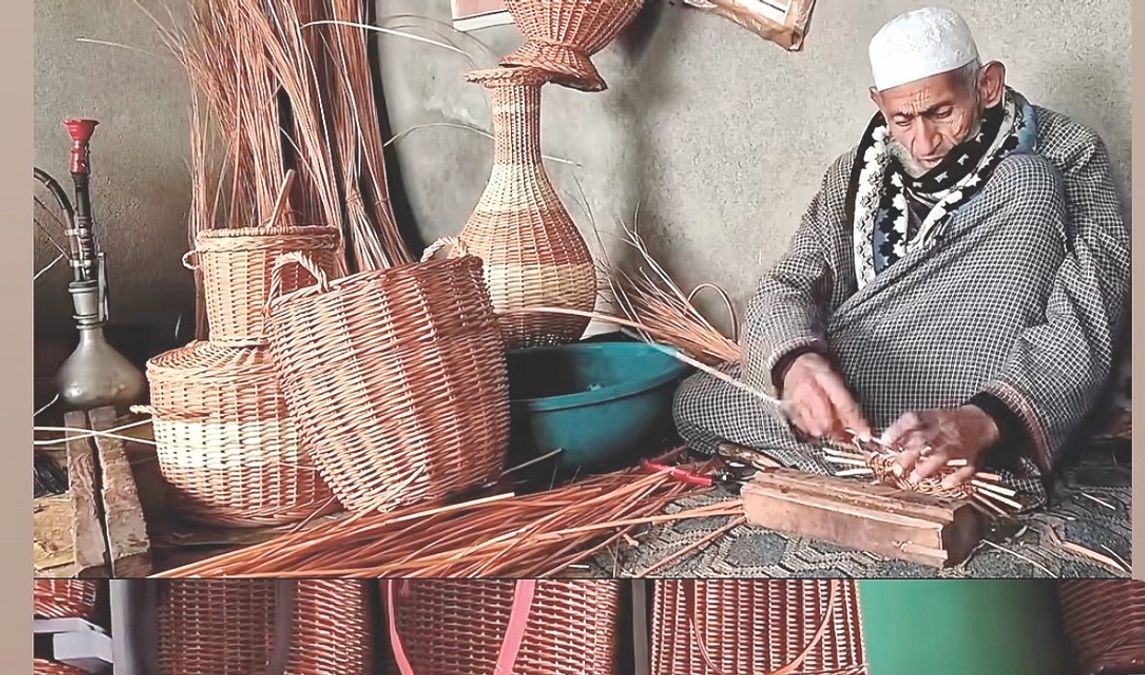
Ganderbal, Nov 29: In the narrow lanes and courtyards of Shallabugh village in central Kashmir’s Ganderbal district, the rhythmic bending and weaving of willow twigs has been part of everyday life for generations. Skilled hands transform slender willow branches into kangris (traditional firepots), baskets, trays, cradles, chairs and decorative household products. But behind this centuries-old craftsmanship lies an increasingly uncertain livelihood, with artisans struggling against dwindling raw materials, rising production costs and declining interest among the younger generation.
Known as one of Kashmir’s principal willow wickerwork centres, Shallabugh has nearly 70 percent of its population associated with the craft, involving both men and women. Located around eight kilometres from Ganderbal town, the village was accorded Model Village status in 2002 and is regarded as one of the largest producers of willow baskets in Kashmir.
Nearly 5,000 people belonging to around 600 families in Shallabugh depend on willow wickerwork for their livelihood. Despite the scale of production and the intricate designs of its products, artisans say the craft has failed to provide them with a decent standard of living, leaving many families struggling to make ends meet.
The traditional wicker craft, locally known as ‘Kanil Kaem’, is practised in several villages across Ganderbal, including Shallabugh, Harran, Peerpora, Tehlipora, Kachan and Gundi Rehman. Other centres such as Gadora, Kujur, Gogjigund, Fakirgund and Sindbal are also involved in manufacturing willow products.
The range includes baskets, trays, chairs, decorative items and other household products, some of which have traditionally found markets outside Kashmir, including other parts of the country and overseas.
For decades, the craft has remained an economic backbone for hundreds of families in the district. Artisans, however, say it is now being squeezed from several directions: shrinking availability of raw willow, labour-intensive production methods, rising input costs and competition from cheaper plastic alternatives.
The foundation of wickerwork is high-quality, pliable willow, traditionally grown along marshy lands and water bodies across central Kashmir. Artisans say rapid urbanisation, shrinking wetlands and changes in land use have reduced the availability of locally grown willow, forcing them to procure raw material from distant areas or through middlemen at higher prices.
“We used to harvest willow right near our villages at affordable rates. Now, we have to travel far or buy from middlemen at steep prices. By the time we factor in transport and raw material costs, barely anything is left as profit,” said Ghulam Mohammad, a third-generation artisan whose family has been associated with basket weaving for over five decades.
To address the shortage, the artisan community is seeking the allocation of dedicated government land for organised willow cultivation in and around Ganderbal.
They say establishing plantations would help ensure a reliable supply of raw material, reduce dependence on middlemen, stabilise production costs and ease pressure on existing natural resources and wetlands.
Another major demand concerns the processing of raw willow, which involves considerable manual labour and time.
Before a willow branch can be woven, its bark has to be removed and the material boiled to make it flexible and durable. Most artisan families currently depend on makeshift drums heated over open fires using firewood. The process, they say, is time-consuming, expensive and exposes workers to smoke and prolonged heat.
Artisans have urged the Handicrafts and Handloom Department to establish community-level steam boilers to modernise the processing stage and improve the quality of finished products.
“Boiling willow over open wood fires takes hours, consumes huge amounts of fuelwood, and ruins our lungs and eyesight,” said Shameema Bano, a woman artisan who works alongside her husband.
“Modern boilers would cut processing time in half, reduce fuel expenses, and give the willow a cleaner, more uniform finish that fetches better prices in outside markets,” she said.
The absence of modern infrastructure, artisans argue, affects not only the quality of products but also their ability to compete in wider markets.
Abdul Rehman, another artisan, said wickerwork involved several laborious stages, beginning with harvesting the willow crop and continuing through processing and weaving before a finished product emerged.
“It goes through different stages right from once the crop is harvested,” he said, adding that skilled men and women painstakingly interweave thin and flexible reeds to produce attractive and intricate items.
He said the finished products had considerable appeal among customers, but artisans were struggling to expand their markets.
Several workers said most of the products were sold within Kashmir, while demand from outside markets remained relatively low.
They attributed this to inadequate infrastructure and the absence of modern processing facilities, which make large-scale production difficult.
“If you have the requisite infrastructure, many stages can be omitted and you can produce more goods in less time,” said a local artisan who has been associated with the craft for around 20 years.
Perhaps the most pressing concern for the artisan community is the declining interest among young people in taking up the traditional occupation.
With earnings often lower than those available through other forms of manual employment, younger generations see little incentive to spend years mastering the intricate weaving techniques.
Artisans say the younger generation has increasingly begun looking for alternative occupations, raising concerns about the transmission of skills that have been passed down through families for generations.
“Our children watch us work from dawn to dusk just to make ends meet, so naturally they look for other jobs,” said Bashir Ahmad, president of a local artisans’ cooperative.
He said the establishment of a Common Facility Centre (CFC) in Ganderbal could help address several of the challenges facing the sector.
The proposed centre, artisans say, should house shared machinery, including modern boilers and seasoning facilities, while also functioning as a training and design hub.
They want the centre to provide young men and women with training in contemporary product designs, quality control and e-commerce marketing, besides offering modest stipends during the training period.
“If the government sets up a Common Facility Centre in Ganderbal, we can train the next generation in contemporary furniture and export-grade designs. The craft doesn’t lack global demand—it lacks infrastructure,” Bashir said.
Artisans also expressed concern over the declining popularity of traditional wicker products in the domestic market, where cheaper plastic alternatives have increasingly replaced many household items once made from willow.
They said the growing availability of plastic baskets and other substitutes had affected demand for handmade wicker products and urged the government to consider restrictions on plastic items that directly replace traditional wicker goods.
Hundreds of artisans associated with the craft across Kashmir, they said, were finding it increasingly difficult to earn a decent livelihood.
“Only those who don’t find a better opportunity, like me, are forced to do the wickerwork,” said an artisan, reflecting the declining appeal of the occupation among younger people.
The artisans believe that without institutional support, the traditional craft could gradually lose both its workforce and its market.
An official from the Handicrafts Department said willow wickerwork was an important traditional craft and needed to be encouraged and promoted.
He said the department was working to take the craft to higher platforms and ensure that people associated with it did not have grievances.
Efforts were also being made to upgrade artisans’ skills and provide the necessary financial and infrastructural support, the official said.
For the artisans of Shallabugh and other wicker-producing villages of Ganderbal, the demands are straightforward: land to cultivate willow, modern boilers to reduce the burden of processing, and a Common Facility Centre to improve production, design and marketing.
They say the future of the craft will depend not merely on preserving its traditional weaving techniques but on making it economically viable for the next generation.