Home Blog Page 1044

Study shows bacterial infections trigger heart attacks

0
Only 3 out of 5 heart failure patients see cardiologist at least once a year: Study

New Delhi, Aug 28: Myocardial infarction, commonly known as heart attacks, may also be triggered by infectious diseases, finds a study, which showed that dormant bacteria can cause the deadly condition.

The pioneering study by researchers from Finland and the UK demonstrated that the discovery challenges the conventional understanding of the pathogenesis of heart attacks and opens new avenues for treatment, diagnostics, and even vaccine development.

Professor Pekka Karhunen, from Tampere University in Finland, who led the study, notes that until now, it was assumed that events leading to coronary artery disease were only initiated by oxidised low-density lipoprotein (LDL), which the body recognises as a foreign structure.

“Bacterial involvement in coronary artery disease has long been suspected, but direct and convincing evidence has been lacking,” Karhunen added.

The study, published in the Journal of the American Heart Association, revealed that an infection may trigger myocardial infarction.

Using a range of advanced methodologies, the research found that, in coronary artery disease, atherosclerotic plaques containing cholesterol may harbour a gelatinous, asymptomatic biofilm formed by bacteria over years or even decades.

Dormant bacteria within the biofilm remain shielded from both the patient’s immune system and antibiotics because they cannot penetrate the biofilm matrix.

A viral infection or another external trigger may activate the biofilm, leading to the proliferation of bacteria and an inflammatory response.

The inflammation can cause a rupture in the fibrous cap of the plaque, resulting in thrombus formation and ultimately myocardial infarction.

“Our study demonstrated the presence of genetic material — DNA — from several oral bacteria inside atherosclerotic plaques,” the researcher said.

The findings were also validated by developing an antibody targeted at the discovered bacteria, which unexpectedly revealed biofilm structures in arterial tissue.

Bacteria released from the biofilm were observed in cases of myocardial infarction.

The body’s immune system had responded to these bacteria, triggering inflammation, which ruptured the cholesterol-laden plaque.

The observations pave the way for the development of novel diagnostic and therapeutic strategies for myocardial infarction. Furthermore, they advance the possibility of preventing coronary artery disease and myocardial infarction by vaccination, the team said.


Greater Kashmir

Schools in Jammu division shut till Aug 30 due to floods

0
Inclement weather: Schools closed in J&K's Ramban

Jammu, Aug 28: Authorities on Thursday announced closure of all schools, both government and private, across Jammu division till August 30 in view of heavy rains and related disruptions.

An order issued by Director School Education Jammu, Dr Naseem Javaid Chowdhary stated that continuous downpours had caused waterlogging in many school premises, restricted access in low-lying areas, and posed threats of landslides and shooting stones in hilly regions.

The order pointed out that road damage in several districts had made travel unsafe, and the situation had raised concerns among parents and civil society who had urged authorities to continue the shutdown.

“In the interest of safety of students and staff, all schools in Jammu Division shall remain closed till August 30, 2025,” the order reads.

School heads have been directed to consider online classes, particularly for senior students, where infrastructure allows. They must also ensure cleaning and inspection of buildings before reopening.

The order underlined that institutions must strictly follow prescribed SOPs and consult local administration before resuming physical operations.

Meanwhile, the Directorate said the situation is being monitored closely and further directions will be issued depending on weather conditions. (KNC)

Greater Kashmir

Kashmiri pandits begin Ganesh Chaturthi festivities in Valley

0
Kashmiri pandits begin Ganesh Chaturthi festivities in Valley

Srinagar, Aug 28: Kashmiri pandits in the Valley have begun festivities to celebrate Ganesh Chaturthi with fervour and devotion.

The festival, traditionally known as Vinayak Tchoram, is marked by the installation of Ganesha ‘murtis’ (idols) in homes and on elaborate ‘pandals’.

This year’s celebrations began on Wednesday, with grand religious ceremonies being held at the Siddhivinayak Ganpatyar temple here, All PM Package Employees Welfare Association in Indira Nagar, Shiv Temple, and Vessu KP Colony in Anantnag.

Like the previous year, ‘hawans’ (sacred fire rituals) and ‘prasad’ distribution have been organised to celebrate the auspicious occasion.

These events are being held with an instrumental support from Shri Bausaheb Rangari Trust in Pune, headed by Punit Balan, who has provided eco-friendly Ganesha idols to ensure that the celebrations are environmentally responsible.

In addition to the religious ceremonies, five days of cultural and ‘bhajan’ evenings have been planned to bring the community together in a celebration of devotion and culture.

The festival will culminate in a procession for the immersion of Ganesha idols, which will be carried from the Ganpatyar Mandir, Shiva Temple, and the Vessu KP Colony to the banks of the Vitasta Jhelum River.

This traditional procession, scheduled for August 31 and September 2, is a major highlight of the celebrations.

A unique feature of the festival, known as ‘Pann Pooza’, involves the preparation of sweet bread as an offering to Lord Ganesha. This sacred bread is later distributed among family members and friends, symbolising unity and communal bonding.

Despite the challenges faced during the militancy years, the local Muslim community in Kashmir continues to witness and participate in the celebrations, reflecting the enduring spirit of communal harmony that transcends religious boundaries.

The participation of the local Muslim-majority population highlights the deep-rooted bonds of brotherhood and mutual respect in the Valley.

Greater Kashmir

States can’t file writ petitions in SC against actions of Prez, Guv in dealing with bills: Centre

0
States can't file writ petitions in SC against actions of Prez, Guv in dealing with bills: Centre

New Delhi, Aug 28: The Centre on Thursday told the Supreme Court that state governments cannot invoke writ jurisdiction in moving the apex court against the actions of the President and the governor in dealing with the bills passed by assemblies for violation of fundamental rights.

A five-judge bench Constitution bench headed by Chief Justice BR Gavai was told by Solicitor General Tushar Mehta, appearing for the Centre, that the President would like to have an opinion of the apex court on whether states can file writ petition under Article 32 of the Constitution for violation of fundamental rights.

He said the President would also like to have an opinion on the scope of Article 361 of the Constitution which says the President, or the Governor will not be answerable to any court for the exercise and performance of the powers and duties of his office or for any act done.

Mehta told the bench also comprising Justices Surya Kant, Vikram Nath, PS Narasimha and AS Chandurkar that they have debated over these questions in the reference but the President is of the opinion that she would like to have the view of the court to know the exact legal position as issue may arise in the future.

He submitted that Article 32 petition on behalf of the state against the action of the governor and the President cannot be filed as it is not maintainable, no direction can be issued to them and thirdly the action of the governor and the President in dealing with the bills is not justiciable.

“Article 32 lies when there is violation of fundamental rights and state government in the constitutional scheme does not in itself have the fundamental right. It is a repository of functions which is to protect fundamental rights of its people,” Mehta said.

The solicitor general referred to the April 8 Tamil Nadu verdict in which states were given liberty to approach the apex court directly in case timeline is not adhered by the governor in clearing the bills passed by the assembly.

CJI Gavai said it will not say any words with regard to the two-judge verdict of April 8 but the Governor would not be justified in sitting over the bill for six months

Mehta submitted that one constitutional organ not discharging his duties, does not entitle the court to direct another constitutional organ.

The CJI said, “Yes. We know what your argument is? If this court does not decide the matter for 10 years, would it be justified for the President to issue an order.”

The hearing is underway.

On August 26, the top court wondered whether the court should sit powerless if a Governor delays assent to bills indefinitely and if the constitutional functionary’s independent power to withhold a bill would mean that even money bills could be blocked.

The court raised the questions after some BJP-ruled states defended the autonomy of Governors and President in assenting to bills passed by a legislature, submitting that “assent to a law cannot be given by court”. The state governments also contended that judiciary cannot be a pill for every disease.

The top court is hearing the Presidential reference on whether the court could impose timelines for governors and President to deal with bills passed by state assemblies.

In May, President Droupadi Murmu exercised powers under Article 143(1) to know from the top court whether judicial orders could impose timelines for the exercise of discretion by the president while dealing with bills passed by state assemblies.

Greater Kashmir

India may become world’s 2nd-largest economy by 2038 with $34.2 trillion GDP: Report

0
India may become world’s 2nd-largest economy by 2038 with $34.2 trillion GDP: Report

Srinagar, Aug 28: According to the August 2025 edition of EY Economy Watch, the Indian economy is projected to grow significantly, reaching $20.7 trillion by 2030 and potentially $34.2 trillion by 2038. This optimistic outlook is driven by strong economic fundamentals, favourable demographics, and ongoing structural reforms.

India currently holds the position of the fourth-largest economy in the world by nominal GDP, with an estimated size of $4.19 trillion. With a median age of just 28.8 years, high savings and investment rates, and a declining debt-to-GDP ratio — expected to drop from 81.3% in 2024 to 75.8% by 2030 — India is well-positioned to surpass other major economies. The report suggests that India could become the second-largest economy globally within the next 13 years.

According to reports, among major economies, China is projected to reach $42.2 trillion GDP (measured at Purchasing Power Parity) by 2030 but faces challenges from an ageing population and rising debt. The US remains strong but contends with high debt exceeding 120 per cent of GDP and slower growth. Germany and Japan, though advanced, are constrained by older populations and heavy reliance on global trade.

Structural reforms—such as the implementation of the Goods and Services Tax (GST), the Insolvency and Bankruptcy Code (IBC), UPI-driven financial inclusion, and Production-Linked Incentive (PLI) schemes—are boosting industrial competitiveness across sectors. India is projected to overtake Germany by 2028 to become the world’s third-largest economy in terms of market exchange rates. Even potential headwinds, such as U.S. tariffs impacting 0.9% of GDP, are expected to have only a marginal effect, with robust domestic demand and diversified exports limiting the slowdown to just 0.1 percentage point.


Greater Kashmir

Ukraine conflict is ‘Modi’s war’, claims White House trade adviser

0
Ukraine conflict is ‘Modi's war’, claims White House trade adviser

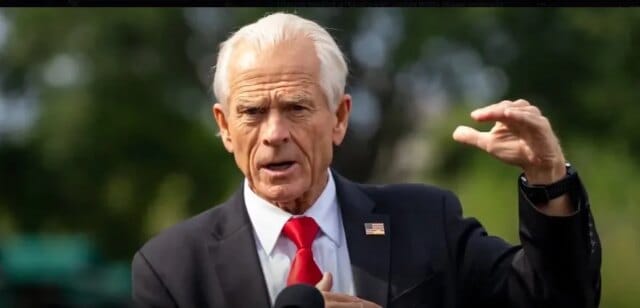
New York, Aug 28: The Ukraine conflict is “Modi’s war”, White House trade adviser Peter Navarro has alleged, saying the “road to peace” runs partly “right through New Delhi”.

Navarro, President Donald Trump’s Senior Counsellor for Trade and Manufacturing, in an interview to Bloomberg on Wednesday claimed that “India is helping feed the Russian war machine”.

“Everybody in America loses because of what India is doing. The consumers and businesses and everything lose, and workers lose because India’s high tariffs cost us jobs and factories and income and higher wages, and then the taxpayers lose, because we got to fund Modi’s war,” Navarro said.

When asked by the host if he meant “Putin’s war”, Navarro reiterated that it is “Modi’s war”.

“I mean Modi’s war, because the road to peace runs, in part, through New Delhi,” he added.

Trump has imposed an additional 25 per cent tariffs on India for its purchases of Russian oil, levies that came into effect from Wednesday, bringing the total duties slapped on India to 50 per cent.

Navarro claimed it is “real easy” for the 25 per cent additional tariffs imposed on India to go away and for that New Delhi has to stop buying Russian oil.

“India can get 25 per cent off tomorrow if it stops buying Russian oil and helping to feed their war machine,” Navarro said.

Calling Prime Minister Narendra Modi “a great leader”, Navarro said he was puzzled as “this is a mature democracy with intelligent people running it, and they look us bald-faced in the eye on the tariff part and say, ‘we don’t have the highest tariffs in the world’, when, in fact, they do”.

“There’s no dispute about that. If you look at the numbers and then they say…, ‘We’re not going to stop buying Russian oil’. Now, what does that mean?”

Navarro said.

The trade adviser then further alleged that India buys Russian oil at a discount and then Indian refiners, in partnership with Russian refiners, sell it at a premium to the rest of the world.

“Russia uses the money it gets to fund its war machine, kill more Ukrainians. And then the next thing that happens, of course, is Ukraine comes to the US and Europe and says, give us some more money,” Navarro added.

India has called the tariffs imposed by the US “unjustified and unreasonable”.

New Delhi has said that, like any major economy, it will take all necessary measures to safeguard its national interests and economic security.

The trade adviser further said that India is the biggest democracy in the world and it should “act like one” and “not side with the authoritarians”.

There was no immediate comment from New Delhi on Navarro’s statement.

Responding to a question on China, Navarro said he is “so tired” of these national security strategies.

“The reality is you have to stop India and China from buying Russian oil. You do that tomorrow, and the war is over,” he said.

Navarro added that if everybody, including Europe, just stopped buying Russian oil, then it’s only a matter of time before Russian President Vladimir Putin doesn’t have the money to fund that war.

Meanwhile, the House Foreign Affairs Committee in a social media post said that instead of imposing sanctions on China or others purchasing larger amounts of Russian oil, “Trump’s singling out India with tariffs, hurting Americans and sabotaging the US-India relationship in the process. It’s almost like it’s not about Ukraine at all.”

Greater Kashmir

Assembly suspends committee meetings until September 5

0
J&K Cabinet to meet in Srinagar, Assembly session on agenda

Srinagar, Aug 28: The Jammu and Kashmir Assembly secretariat has cancelled all meetings of the House Committees till September 5 in view of floods in the Union Territory.

Citing flood-like situation in Jammu & Kashmir, the Legislative Assembly secretariat has ordered postponement/ cancellation of all scheduled meetings of the House Committees.

“In view of prevailing inclement weather conditions in the Union Territory of Jammu and Kashmir, and the consequent flood-like situation reported in various areas, besides as the administration is fully engaged in dealing with the emergent situation arising out of the adverse weather conditions, it has been decided that all scheduled meetings of the House Committees, the Financial Committees, as well as other Committees of the Legislative Assembly, stands postponed/cancelled till the 5th of September, 2025,” reads a notification issued by Legislative Assembly secretariat. (KNO)

Greater Kashmir

Monsoon threat persists, next 15 days critical: Div Com Kashmir

0
Next 15 days crucial as monsoon continues, follow weather advisories: Div Com Kashmir

Srinagar, Aug 28: Divisional Commissioner Kashmir, Anshul Garg, on Thursday praised the people of Kashmir for their courage and cooperation in dealing with the recent flood situation. He said the next 10–15 days are crucial and urged residents to strictly follow weather advisories.

Garg said the water level in the Jhelum has receded but stressed that teams remain on “high alert.”

“I would like to congratulate the people for managing the situation with calm and resilience. All teams were monitoring closely, but it is the citizens’ awareness and courage that made the difference,” he said while addressing a press conference at his office chamber, according to news agency Kashmir News Observer (KNO).

He emphasized that the coming days are critical, urging residents to stay vigilant, particularly near the Jhelum and its tributaries. “The next 40 days are important as the monsoon continues. With public support, our teams can handle any challenge,” he added.

Garg appreciated the coordinated efforts of the Army, Police, SDRF, NDRF, and the Irrigation & Flood Control Department, noting that over 150 vulnerable spots were being monitored, with no breaches reported in the last 48 hours.

He said water levels at Ram Munshi Bagh and Sangam have receded, reflecting effective departmental work as well as community cooperation. He also urged citizens to share suggestions for long-term flood preparedness.

The Divisional Commissioner reassured residents that the situation is under control and expressed confidence that continued cooperation will help keep Kashmir safe during the monsoon season. —(KNO)

Greater Kashmir

Jhelum water level begins to recede in Srinagar, monitoring continues

0
Jhelum water level begins to recede in Srinagar, monitoring continues

Srinagar, August 28: The water level of the Jhelum River at Ram Munshi Bagh in Srinagar has started to decline after staying above the danger mark overnight, according to officials from the Irrigation and Flood Control Department.

As per real-time data, the river measured 21.03 feet at 1:09 AM but dropped to 20.53 feet by 7:09 AM. Although the level is now below the danger mark, authorities have stated that close observation will continue, especially in areas vulnerable to flooding.

Officials said field teams remain deployed across various parts of the Kashmir Valley to monitor the river’s behaviour and respond to any changes.

The department has maintained hourly surveillance at key locations to track water levels and potential threats to surrounding areas.

Divisional Commissioner Kashmir Anshul Garg said that government agencies are maintaining a state of readiness and that field officers are coordinating closely to ensure timely interventions if required.

He added that emergency response systems and evacuation plans remain in place.

In a high-level review held early Thursday morning, Chief Minister Omar Abdullah assessed the ground situation with senior officials.

He directed the administration to ensure the continued supply of essential items such as food and medicine, and instructed that temporary shelter arrangements remain functional for those affected by the rising water.

Authorities have urged residents in low-lying areas to stay alert and follow instructions issued by local administration. Updates on the river’s status will continue to be shared through official channels as the situation evolves.

No major breaches or displacements have been reported so far, but officials reiterated that precautionary measures would remain in effect until the risk fully subsides. (KNS)

Greater Kashmir

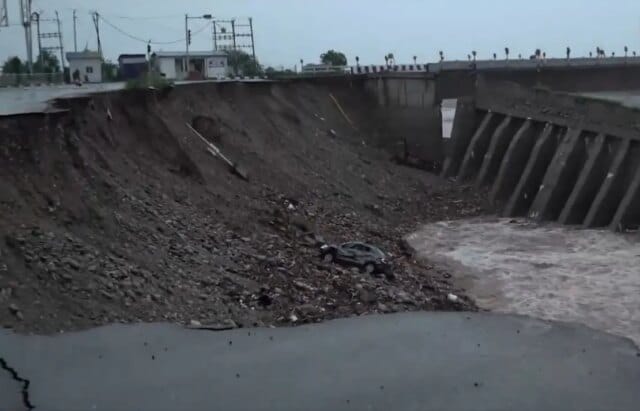
Incessant rains trigger floods in Jammu; Tawi floods wash away road near 4th bridge in Jammu

0
J-K: Incessant rains trigger floods in Jammu; Tawi floods wash away road near 4th bridge in Jammu

Jammu, August 28: Heavy rainfall in Jammu and Kashmir has caused severe flooding, particularly in the Jammu region, due to the overflow of the Tawi River. The floodwaters have damaged several houses and shops in the area.

A portion of the road along the fourth Tawi bridge has been washed away in the floods following incessant heavy rainfall.

Locals in Jammu reported that approximately 35 houses and 6 shops were affected by the floods in the Belicharana area of Jammu.

Houses were also damaged in the Bhaderwah area of Doda district due to flash floods and heavy rainfall in the region. Residents of Bhaderwah have been moved to safer places in the aftermath of the flash floods.

Speaking to ANI, a resident of Bhaderwah, Ganesh, who had relocated to another area, stated that his entire house had been damaged after debris fell on it.

He said, “A loud sound was heard at around 2:30-3 AM. After a while, a lot of debris came down and everything in our house was damaged. We somehow saved our lives. My entire house is damaged. We are staying at someone else’s house now…”

Meanwhile, the water level of the River Jhelum has also risen in Srinagar following incessant rainfall in the region.

According to the IMD, there will be “a significant reduction in rainfall activity likely over Jammu and Kashmir from today,” however, isolated heavy rainfall spells are likely to continue over Northwest India during the next 6-7 days.

Meanwhile, the Vaishno Devi Shrine Board has taken the responsibility of repatriating the bodies of the landslide victims to their native places.

A devastating landslide occurred near the Vaishno Devi temple in Katra, Jammu and Kashmir’s Reasi district, claiming more than 30 lives and injuring 20 others. The disaster struck on Tuesday afternoon, around 3 pm, when heavy rains triggered a massive landslide near the Inderprastha Bhojnalaya at Adhkuwari, about halfway along the 12-kilometre trek from Katra to the shrine.

Earlier on Wednesday, Jammu and Kashmir Lieutenant Governor Manoj Sinha chaired a high-level meeting to review the rescue and relief operations and preparedness of the Union Territory following the landslide that occurred near the Vaishno Devi shrine in Jammu and Kashmir’s Katra, as well as the flash flood situation in several districts.

The Lieutenant Governor directed officials to take every possible measure to ensure that people staying in low-lying flood-affected areas are safely evacuated.

He asked the officials to ensure the maintenance of all essential services, such as power, healthcare, clean drinking water, rations, and teleconnectivity.

He said that the essential services disrupted in flood-affected areas must be restored as a priority, and the natural-disaster-hit regions should have an adequate stock of essential supplies and medicines.

Greater Kashmir

- Advertisement -
Google search engine

Recent Posts